Review
Of
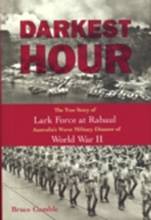
http://www.zenithpress.com/Store/ProductDetails_35894.ncm
Darkest Hour
The True Story of Lark Force at Rabaul
World War II
Gamble,
Bruce.
ISBN:
0-7603-2349-6
Pages: 304
The correctful thing in all literary books
is to remember that the truth may need suppressing if it appears out of tangent
with the common man’s notion of reality.
Trader Horn
Any author who tries to tackle the difficult subject of war time Rabaul and keep the tragedy of what happened in the forefront of Australians conciseness is to be commended. However for me Darkest Hour offers little I didn't already know. With little new information it seems to be a well woven compilation of information that has already been published in other books and information from diaries and unpublished manuscripts in the AWM. It would be hoped that any author of secondary histories would accept the serious responsibility to sift what has been written before and leave things clearer than they found them! This is particularly the case where so much inaccurate surmise has already been written about Rabaul.
Like the first book published on the 2/22nd Battalion and the loss of Rabaul, Rabaul 1942, Darkest Hour (DH) could have done with a good fold out map so the reader isn't constantly flipping back to the small maps trying to work out where all the various groups were. Also as there were so many groups of escaping soldiers of the battalion heading in so many different directions it is difficult to keep the time frame in context. I found the non super scripting of page references very annoying. There is still a lot of information the author didn't find, didn't mention or perhaps didn’t reference.
There is some new information. Interestingly Gamble states
that Captain Shojiro Mizusaki commanding officer of the 81st Naval Garrison [p.
224] was the officer overseeing the movement of the nurses from Vunapope to the Naruto Maru for
transportation to
This day which, oddly
enough, ended in optimism was
Exactly twelve days
after that disturbingly memorable date hordes of Japanese again invaded our
sanctuary. We had just come in from a walk to the
‘This gentleman is
from the House of Mitsubishi. You must obey him,’ said Sugai
totally ignoring the other officers. As none of us, at this stage, had heard of
the House of Mitsubishi this honour was completely
lost on us. Before Sugai could give us any
instruction this important person addressed us in a well educated English
voice.
‘Please, just call me Michael.’ Speechless gasps greeted this invitation - we were all too astonished to call him anything, much less Michael!
If this new
information is correct [and to me it makes sense that it would be Mizusaki, as
the Rabaul nurses were special prisoners to the Japanese at that time],
historians should be raising the question of why an officer of such senior rank
would be involved with moving 18 lowly POW nurses to Japan. But unfortunately
as other historians have in the past the author has missed the significance of
this encounter and not asked any questions.
Comments about specific claims in Darkest Hour
Page 11 last paragraph. “Salvation Army realized that conscription
might come at any time”. Prior to Japans entry in the war, there had been
little discussion of conscription. This had been a huge issue during WWI
causing a split in the Labor Party and their loss of Government. The government
had actually suspended enlistment to the 2nd AIF in July 1940. Some members of
the Salvation Army may have used the prospect of conscription to justify their
service enlistment after the war, to pacifists within their own community but
it was not an issue during 1940 and early 41. Although conscription was
subsequently introduced in at end first quarter 42, after the fall of
Page 13 3rd paragraph, discussion of the relationship with the CMF to the Australian Army and comparison to the US National Guard movement. This is entirely wrong. The CMF was the Australian Army. From federation, the structure of the Australian Army was as the part-time CMF with a small number of full-time personnel, the latter limited to coastal artillery, engineers, service corps (logistic transport support) ordinance corps (logistic support) and the instructional corps. It had been a point of conflict that an officer wanting a regular army career in the combatant arms had to be attached to the instructional corps and had a much slower rate of progress than a part-time officer and also had a lower priority for attachment to the Indian Army for critical training courses required for progress past the rank of captain. The 1st & 2nd AIF were entirely recruited "for the duration" of the war and disbanded at the end of their respective wars. The regular peacetime army was not founded until afterWW2.
Page 19 2nd paragraph "focus their attention on
the main land warfare theatre for British troops. The 2nd AIF was heavily committed to the disastrous Greek campaign, where heavy losses occurred.
Also, only 3 divisions were committed to the North African
campaigns (6, 7 & 9th.) The 8th remained in
bulk as a garrison to
Page 19 last paragraph discussing AIF
recruitment. See previous comments. To get a better understanding,
supported by statistics, see Jeffrey Grey "A military history of
Page 20 1st paragraph. States
Australian attitude was that the US & Macarthur provided a shield in the
There is some evidence that the
Americans were strategically interested in Rabaul and that they were covertly
involved in the building of the Vunakanau upper
aerodrome. [see unpublished manuscript “Memories of
New Guinea Rabaul 1937 -1942” by Harry Morris p.25]
Page 20 3rd paragraph. Discussion of Mandated
In 1914 the 1st AN&MEF, (not
AIF and not AMF) was formed to seize and occupy the German colony. After the
war,
Mandated territory administered by
As
Similarly as an
Page 22 1st paragraph.
Under the League of Nations Charter for mandated territories, the construction of fortifications was expressly prohibited. This leads back to what was the role of Lark Force, as a buffer garrison against Japanese expansionism or a garrison to protect the harbour from Nazi German merchant raiders like the Cormoran. As the latter, their role was legitimate within the Charter; however as the former the legality of their role was very questionable. In particular the construction of the 6inch gun emplacements was a questionable activity.
Page 38 Albert Hahl. The main problem with Kokopo is the shallow depth of its harbour. Large ships can't dock there. Although threatened by the volcano its deep water harbour made Rabaul a more viable location.
Page 52 last paragraph. General description of small arms. The rifle in use was the
SMLE No 1 Mk III*. These were newly made for the 2nd AIF being the model
adopted in 1915 and very similar to the Mk111 adopted in 1907. They fired the
Mk7 .303 cartridge which had been adopted during WWI. Rebuilt WWI rifles were
retained in
This situation was similar for most of the world’s armies.
The Japanese troops carried the 6.5mm M38 rifle adopted in 1905, firing an
updated cartridge adopted during WWI. A newer rifle adopted in 1939 firing a
7.7mm cartridge had been adopted but was not used in the Pacific Theatre in
1942. The Germans used the 7.92mm K98 mauser,
being a shortened form of the WWI G98 model, firing the same cartridge. The
Russians used the M30 Moisson Nagant
firing 7.92mm Russian rimmed, being near identical the 1891 model used in WWI.
The Italians used the M38 & M41 6.5mm Carcarno
rifles, being very similar to the 1891 model used in WWI and firing the same
cartridge. The
12 x 3-inch mortars. I cannot
comment on whether this is correct but is unlikely. During WWII the usual
British & Australian deployment was 1 x mortar platoon per battalion, with
4 detachments, each with 1 mortar. i.e. 4 mortars per
battalion. At this time this was a 3-inch Mk2 mortar with a Mk 1 mount and Mk 1 sight. (Latter in the war these were
progressively replaced by the Mk5 with Mk2 sight giving much improved range).
See army training manual "Small Arms
Training Vol. 1 No 9 Mortar 3-inck 1937 (
At the company level, a grenade thrower called a 2-inch mortar was on issue. The employment and scale of issue for these changed at various times through
the war but was generally one unit
per platoon. These were generally equivalent to the Japanese 50mm "knee
mortars" but with less range. They were very inferior to the
Page 58 “Not all women
were able to leave”. The six
civilian/government nurses were offered evacuation but they volunteered as a
group to stay. There was no intervention by H Page and no elderly Government
nurse sailed to
Reference to the Government nurses volunteering to stay can be found in the court of enquiry into the fall of Rabaul that was conducted by the Australian Government in early 1942.
See http://naa12.naa.gov.au/scripts/imagine.asp?B=1588037&I=84&SE=0 page 84
See also Lost Women of Rabaul page 203, Not Now Tomorrow page 17
It should be noted that the AANS nurses were never offered
evacuation as it was deemed their duty to stay with the men. Gamble maybe
referring to the fact that Joyce Oldroyd – Harris was flown in as relief matron
for Namanula hospital on
Page 94 and 116 Have Selby spelt
Page 120 "they squabbled like children about food" this statement is not referenced but Gordon Thomas wrote of this:
Hunger over-rode any scruples we might have had regarding the manner in which it was served. Europeans, Asiatics and natives all joined in the general scramble for food. [Rabaul 1942-1945 by Gordon Thomas. Unpublished p.24]
To my mind scrambling and squabbling are two different things...
Page 146 "they were bitterly disappointed that on had come for them" missing words.
Page 187 has Colin Dowse dying just before the arrival of
the Laurabada, page 193 has him dying after arriving back in
Page 202 “only comprehensive narrative among the prisoners from Lark force”. This is a big call. The author hasn't read any of the Rabaul nurse’s diaries and although not a member of Lark Force Gordon Thomas wrote a book entitled Rabaul 1942-1945 which was never published. Bishop Scharmach also wrote "This Crowd beats us all". The author makes reference to neither.
Page 210 3rd paragraph “The
most reverend Leo Scharmach and his staff were Germans; they were treated with the same contempt as
the Australians”. This is incorrect.
Bishop Leo Scharmach was Polish but had served in the German army as a
stretcher bearer in WW1. He had a German iron cross medal which he used to
great effect in influencing the Japanese. When the order was received from
Page 211 The comment that Bishop Leo Scharmach resembled Groucho Marx was unnecessary and possibly gives the reader the wrong impression. The author goes on to state that he could do little about the Japanese sexual advances and the guards punishing the nuns at Vunapope. Nuns were abused as the author states but they were the little native nuns at the top of the Ramale valley who were out side the Bishops sphere of influence. See “This Crowd Beats Us All” page 247 Native Sisters Tortured.
On page 32 of This
Crowd Beats us All Bishop Scharmach wrote:
FURTHER INCIDENTS
THE SISTER’S VEIL
One fine morning a
half-caste boy came running up to me. Breathlessly he reported: “Two Japanese soldiers
have torn off a veil from a Sister’s head.” Then excitedly he exclaimed: “Here,
here they come.”
Two guards with fixed
bayonets were approaching. I walked up to them, stopped them, and in true
Japanese fashion gave them a “dressing down.” Putting my fist under their
noses, I said: “What have you done, you blighters? Don’t you dare touch a
Sister or her sacred veil. You will be sorry for
yourselves if I report you to Colonel Kwata!” Though
they probably never understood every word I spoke, their guilty consciences
made my rebuke clear to them. There they were,
conquerors with their fixed bayonets very crest-fallen and with bent heads.
They allowed the storm to pass. Quite a number of Japanese soldiers witnessed
the affair. I let them go and went to the Sisters to get their version of the
incident.“Oh, yes,” they said, “the two soldiers attempted to tear off a
Sister’s veil but she was too quick for them and escaped unharmed.” So I let
the matter rest at that and did not report them.
It is true that the Bishop trod a very fine line with the Japanese but he managed to survive the war and saved the missionaries under his care.
Page 212 the author references the death of Gray to Not Now Tomorrow. None of the 7 Rabaul
nurses diaries I have copies of make any mention of the death of Gray, some did
however name him as being executed on war crimes affidavits in
From Darkest Hour
At Rabaul, captured soldiers and airmen were subjected to some of the
worst atrocities. John Gray, the engineering officer captured at Tol, was the
victim of a particularly heinous crime committed by members of the 3rd
Battalion. Taken to Vunapope rather than imprisoned at the
Reference given by
author Page 281 Torture and execution of Capt. Gray including “in order to
study” Reference Bowman P.70 Not Now Tomorrow
What was written page 70 Not Now Tomorrow:
Much in evidence these
days was a nasty little Japanese doctor called Chikami
- and referred to by our men as Sunshine Sam. Just how diabolical and
cold-blooded he was we were to learn. He was responsible for an atrocity, in
face of all others, hard to believe. Captain Gray of Engineer Services had been
captured by the Japs soon after the fall of Rabaul.
He refused to give information about the Australian Army and was tied to a tree
near the Bishop’s residence, a residence which was now occupied by the Japanese
Army officer in charge of the Japs at Vunapope,
Lieutenant Colonel Kuata. After brutal interrogation
Captain Gray was repeatedly beaten, but his courage was entwined in the fibres of his heart and his torturers could gain no
information from him. He was taken to a nearby coconut plantation where
missionaries were forced to witness his macabre execution. Doctor Chikami cut out this brave man’s heart while he was still
alive “in order to study his reactions”
The original story from This Crowd Beats us All:
Again there was the
case of Captain Gray of the 2/22 Battalion who was taken prisoner on the way to
freedom. We do not know all the details of what happened. However, some of our
seminarians, who were not confined to their house but who were forced to do all
kinds of small jobs for the Japanese soldiers and were thus able to move about
more freely, reported to us that they witnessed the following incidents.
On the morning of a
bright sunny day, Captain Gray was seen tied to a coconut tree some 50 yards
from the Bishop’s House. He was ordered to disclose military information on the
whereabouts of the Australian Army. He refused and was beaten. He was then left
alone until the officers returned, repeated their questions,
“beat him up” again, and for a second time tied to that tree in the blazing
tropical sun. That procedure was repeated periodically till
At
With the Bishop stating “We do not know all the details of what happened” it is at best hearsay evidence.
Page 213 Definition of “soon" - in a
prompt manner.
Page 217 Lex Frazer couldn’t speak
fluent Japanese. He could speak enough Japanese to survive and could make
himself understood. He was liaison officer for the Rabaul camp. I spoke to Lex 30/1/2007. He also stated that the officers and nurses
sang the song "Old Angzine"
in the hold of the Naruto Maru on their way to
Page 245 2 paragraph which took them to a swimming beach near Rabaul. The nurses were taken to a wharf where they were taken by landing barge to the Naruto Maru.
Page 245 4 paragraph Thomas and the other men with him were never housed in the camp. They were housed at the Rabaul ice works. The question the author has failed to ask is why weren't they going with the other men on the Montevideo Maru? By that time they weren’t essential to the daily running of Rabaul. Why did the 3 from the Rabaul ice house survive when the other civilian men left behind didn’t? There was a reason...
See Lost Women of Rabaul page 34.
Page 248 they had little food on the Nauto Maru. The men had brought a few tins of Bully beef and they had hard dog biscuits before boarding. No reference?
Lorna Whytes diary states:
Small tin water every other day to wash.
Meals mostly rice. Our trip made
very comfortable by our
soldier companions who had some extra food
Lost Women of Rabaul p. 49
Page 257 it wasn't a Red Cross Representative that visited the nurses at Totsuka it was a delegate of the Swiss Legation Erwin Ruch. The nurses were never misplaced; they were for want of a better term, political prisoners.
The following document is from the Federal Archives, Berne,
Switzerland [translated from French] and is an example of type of information
coming out of
The Swiss minister in
Tokyo M. Camille Gorge who had been in charge of American interests in Japan
since 9 December 1942, sent a telegram in December 1944 stating:
1321 - Australian
Interests - The 18 Internees previously at
See “Lost Women of Rabaul" p.95:
The problem for the Australian authorities would have been
the fact that they didn’t know officially that the Rabaul nurses were in
This leaves the Epilogue.
The author is far too strident and sure of his points when he should realise he's skating on thin ice... - Maybe a lesson there for us all!
I agree with his point about escorts not
being with the Montevideo Maru and being unlikely to proceed to
Japan. However he didn't read Mr Yamaji's account closely enough to see that the line about
picking up Australian survivors had come from the OSK office in 1942, not Mr Yamaji. Although I agree
it was essentially "face-saving" about the abandonment of the
POWs. The author mentions the OSK office on p267, he then, on
p268 writes, "...there
is no evidence to corroborate Yamaji's claim that POWs
were rescued and taken to
Possibly the author should have
written "...there is no evidence to corroborate the OSK Official's claim that POWs
were rescued and taken to
Page 267 “if indeed a member” It is difficult to understand why the author doubts Mr Yamaji authenticity as the sole surviving member of the Montevideo Maru crew. He was invited to tell his story by Australian television after discovery of his survival through Mr Hisashi Noma's book "JAPANESE MERCHANT SHIPS AT WAR".
The section on "bunker oil" is completely over-the-top, particularly since it was a motor ship, and the fuel was light diesel, not the heavy oil of a steamer.
His vehement rejection of the possibility of any singing in the water is wrong. I don't find it strange that people sang in adversity - it was a very "British" thing to do. Remember the band on the Titanic! A little googling gives plenty of other examples...
1) USS President Lincoln (WW1) http://freepages.military.rootsweb.com/~cacunithistories/USS_President_Lincoln.html
Fourteen of the sixteen boats were successfully launched, two being blown up in the explosion of the torpedoes, one aft and one forward. The men left on the ship after the life boats had pulled away, immediately began cutting the lashings of the life rafts and launching them, sliding down life lines onto them, singing and paddling away with whatever wreckage they could pick up for a paddle. It reminded one more of a Sunday school picnic than a race with death, to see them racing one another and singing.
2) HMS Courageous 1939
http://www.time.com/time/magazine/article/0,9171,761974,00.html
Rescue ships, including a
3) HM Troopship Lancastria, 1940
http://www.bbc.co.uk/history/worldwars/wwtwo/lancastria_05.shtml
He describes seeing thousands of men cling desperately to the hull of the ship which sank in just 20 minutes, saying: 'I remember there were thousands of voices singing "Roll Out The Barrel" and "There'll Always Be An England", and for years afterwards I could not stand the sound of those two songs. I was turned around in the water and the next that I saw, nothing. Thousands had gone to a watery grave and I will always remember it, I can't ever forget it.'
4) SS Dorchester 1943
http://www.uscg.mil/reservist/mag1999/aug1999/untold.htm
Minutes later, the
5) HMS Trentonian, 1945
http://www.angelfire.com/on3/hmcstrentonian/survivors.html "We had barely cleared the convoy when we were hit. The torpedo striking the ship at the starboard after depth charge thrower, blowing a large hole in the hull, and flooding the engine room. She settled very quickly and when the Engineer Officer and First Lieutenant said it was beyond repair, I gave the order to abandon ship. The men behaved with great courage and cheerfulness. Fortunately the men in charge of the Depth Charges had set them to safe, otherwise they would have gone off when the ship got down to the prescribed depth and the explosion would have killed most of us. The need for wearing life jackets was borne out by the fact that we lost no one by drowning despite the fact that more than 14 of the crew could not swim. We were in the water for 45 minutes waiting for the Fairmiles to pick us up, the men sang to pass the time and to keep spirits up. The crew’s biggest complaint was the wasted effort they had just put into giving the ship a new coat of paint. The water was 33 degrees, and the effect on one's strength was very noticeable when climbing up the scramble net."
Etc. etc. etc. (All singing away in pretty harrowing circumstances...!)
The authors understanding of the Japanese Prisoner of War Information Bureau [PWIB] is very sparse.
Page 269 – The battle of Midway would have made no difference
to the PWIB - there
were no POWs involved,
and the loss at Midway was a secret in
- The PWIB would not
have been paid, or received rations for the dead POWs on the books!
- The delay in the Navy
providing the Roll to the PWIB could also reflect the
time taken to
re-compile the list in a form suitable for transmission from Rabaul.
- The author then gives
the Japanese too much leeway when he assumes that
the PWIB was designed
to work in the first place. As Major Williams said,
the PWIB actually reflected the Japanese desire not to
provide information
about the massive
losses of POWs under their administration.
There is more to the story of the Montevideo Maru but unfortunately
historians always reach the same conclusion, for they rely heavily on the
minimal information in the Australian and Japanese archival files. But there
is evidence for a more plausible explanation of why the Japanese couldn’t
release details of the sinking of the Montevideo Maru and the other hell ships
during the war. It wasn’t only sheer incompetence on the part of the
PWIB, although this is the un-researched excuse accepted over 60 years ago!
In the case of the Montevideo Maru the acceptance that the PWIB was incompetent
closed the case on
10. FATE OF PW AND CIVILIAN NON-COMBATATS MISSING EX RABAUL
Scraps of information collected at DPW & I, LHQ, over a period of several years prior to Japans surrender,
pointed to the probability that about 1000 PW, officials and civilians had
been embarked at RABAUL in Jun 42 for a destination unknown. Close interrogations
of recovered Aust .PW passing through
This intelligence would have been used by Williams in Japan to secure information from the Japanese on those lost. The same document cited by the author to support the case of “bureaucratic ineptitude” by an agency that was “notoriously inefficient” also states:
It is however
necessary to report that both the Swiss Legation and the IRC officials have
unofficially but in no uncertain terms stated
that in their opinion the information was deliberately withheld. (AWM 54
779/1/1)
see http://www.montevideomaru.info/Montevideo/html/Montevideo%20Maru.htm
The fact that the International Red Cross and the Swiss
Legation knew that information had been deliberately withheld is continuously
over looked by historians as it does not support the more politically favourable official findings
accepted by the Australian Government in 1945. Both the IRC and the Swiss
Legation had people in
Unfortunately the author of Darkest Hour has failed to ask any of these questions and has accepted the official story of the investigation into the Montevideo Maru without questioning the inconstancies in the report that the conclusion is based on.
Although a valiant effort the author of Darkest Hour The True Story of Lark Force at Rabaul should have presented all the facts not only the ones that support the official history. He could have questioned some of the reports that the official history of the Montevideo Maru is based on or at least pointed out some of the problems with the officially accepted history considering it finalizes the death of so many with such little investigation. It is difficult for any reader to decide what they believe in the way of any alternative reason for the withholding of the information of the sinking of the hell ships by the Japanese, other than that supported by the author, when only the information that supports the status quo is presented. The author then emotionally suggests in the last paragraph that:
Ultimately, readers must decide for themselves what they believe
regarding the disaster and the alleged conspiracies. Wherever the truth lies,
the men who were lost must be allowed to rest in peace. Soon enough, their entire
generation will exist only in memory.
Is there a problem here? Surely it is more urgent than ever to research, scrutinize and question the inconstancies of the official findings whilst the generations that experienced and suffered are still alive to confirm or deign what is being written by later day historians.
There
are many great truths which we do not deny, and which nevertheless we do not
fully believe.
Joshua Willis Alexander
For more information on the IRC and the acceptance of Major Williams report read Lost Women of Rabaul. See http://www.montevideomaru.info/Montevideo/html/Nurses.htm
Thanks to Ross Torrington and James Oglethorpe for assistance with this review.