The Secret Document
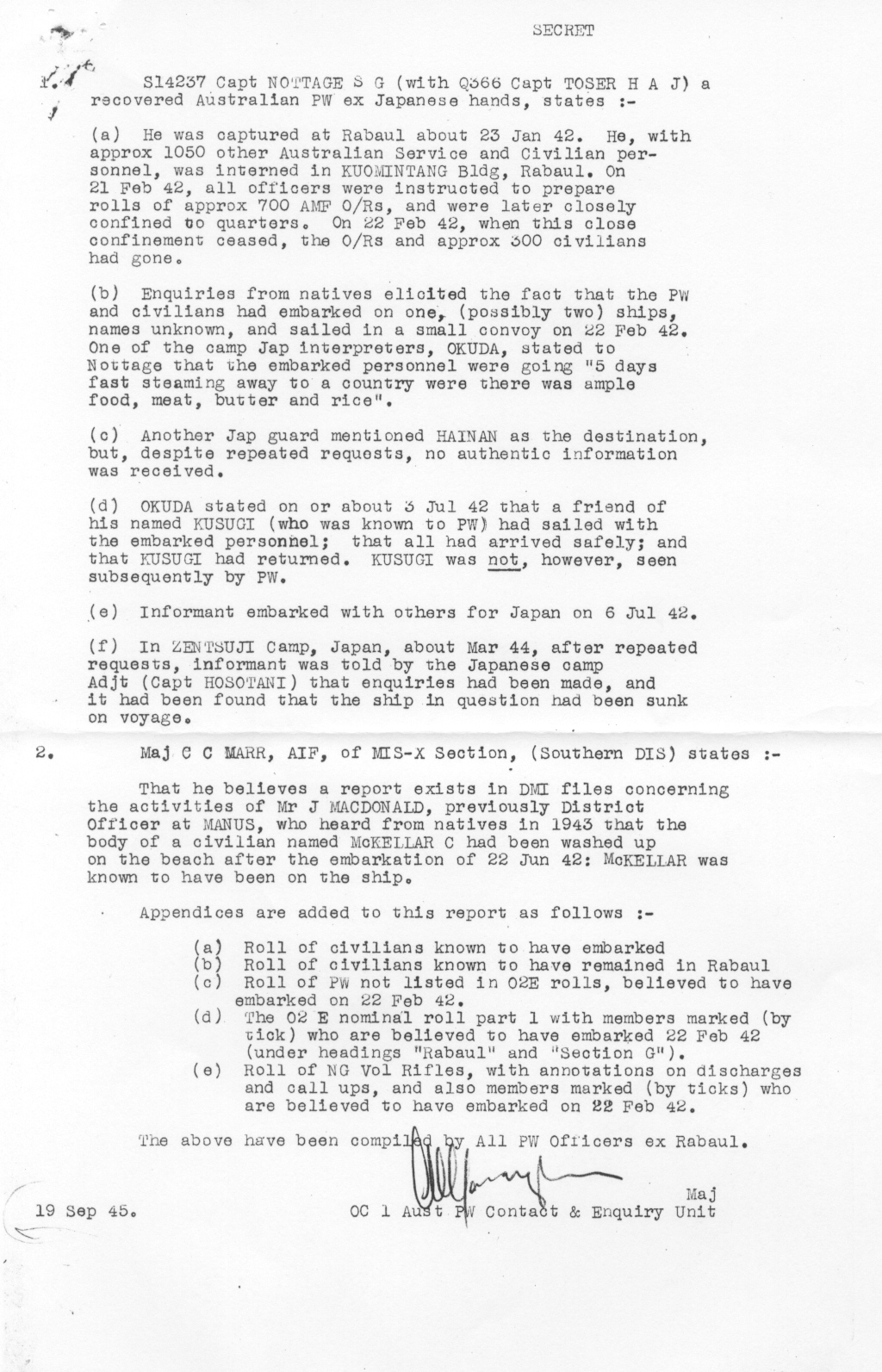
N.A.A MP 742/1 336/1/1955 Box 820
Why was this document classified "Secret"?
It was written by Major G.B.Massingham Commanding Officer of the 1st Australian
Prisoner of War Contact and Enquiry Unit in Manila on the 19th September 1945.
The document seems to be a summary of Cpt Stewart Nottages post war interrogation
report. Stewart Nottage was an officer of the 2/22nd Battalion who had been
transported from Rabaul with the nurses to Yokohama in 1942. It
clearly mentions the possibility of two ships being involved in the transport
of the prisoners. It also supports both John Mays and Peter Brown's statements
that they were told by the Japanese the men were being transported to a nearby
island.
Part 2 refers to the story of the body of C McKellar being washed up on the
shores of Simpson harbour. This information was obtained by a member of Mis
- X section *,which is a mystery in itself, who believed that the information
was contained in the Directorate of Military Intelligence (DMI) files. The
Directorate of Military Intelligence was responsible for providing intelligence
and security advice for the Army. This maybe the reason for the secret classification
of this document. Sister Beranice Twohill who spent the whole of the war in
Rabaul also remembers the natives informing Bishop Scharmach of bodies being
washed up. It is not clear for whom the document above was intended but in
the following document from the Adjutant General 2nd Echelon to the Department
of External Territories Canberra dated 23 October 1945, the matter was dismissed:
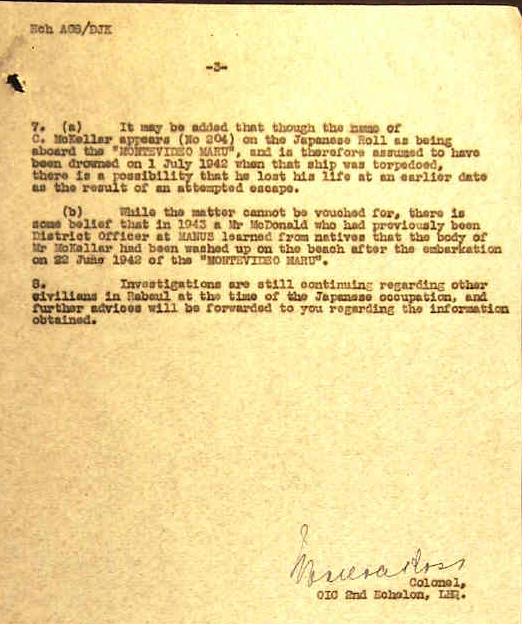
Internees - Australians abroad. Civilians reported lost on board - SS "Montevideo
Maru" [1 cm]
N.A.A Series number A1066 Control symbol IC45/55/3/19 Contents date range
1945 - 1947
Pages 97, 98, 99 of the above file are available for viewing at http://www.naa.gov.au/the_collection/recordsearch.html
Click on Search now- as Guest. In the Key Word Box enter Montevideo Maru and
click search.
You can then view the digitised documents.
It seems that although McKellar's name appears on the nominal roll, discovered by Williams in Japan, to cover the fact that his body may have washed up on the coast, the officer in command of 2nd Echelon decides that McKellar was possibly killed whilst trying to escape. If we are to believe the official history McKellar was on the Montevideo Maru. Since his name was on the nominal roll we have to assume that he was in Rabaul so if he was killed whilst trying to escape why did none of the officers make a report of his escape when being interrogated in Manila on liberation in 1945? Considering in Peter Browns statement that names were checked by the Japanese several times before leaving the camp to board the Montevideo Maru surely McKellars absence would of been noted by the Japanese. If anyone had escaped surely it would of been well known within the Rabaul camp in 1942. Missionary Roger Brown who returned to Rabaul at the end of the war stated that the natives always said that the white masters didn't go on the Montevideo Maru. But the natives were never interrogated at the end of the war. I have as yet found no other documents pertaining to this matter and it is possible that this document may have been the last written on the matter. From a photograph in the AWM we know that Major Massingham was at a conference held at Victoria Barracks Melbourne on the 15th October 1945. The purpose of the conference was to trace missing members of the services in South East Asia and the Pacific area. It was presided over by Colonel J McCahon, Directorate of Prisoners of War and internees (DPW&I). An interesting fact is that Lt Gordon Braden of the 2/22nd battalion who had been a prisoner with Cpt Nottage in Japan and who had been only liberated in September was at this conference. If you wish to view the photograph it is available for viewing on the Australian war memorial web site. The photograph id is 100902. I have not had time to research this conference or the Directorate of Prisoners of War as yet.
Major Williams refers to the DPW&I in his
final report on the Montevideo Maru. Despite repeated requests from the relatives
of the men and the International Red Cross nothing had been heard from the
men since 1942. Due to the information held by DPW&I mentioned in William's
report, surely the government was at least suspicious of their fate prior
to the Japanese surrender.
Major Williams report states:
Scraps of information collected at DPW & I LHQ over the period of several years prior to Japan's surrender, pointed to the probability that about 1000PW, officals and civilians had been embarked at Rabaul in June 42 for a destination unknown. Close interrogations of recovered Aust PW passing through Manila had confirmed this probability.
AWM 54 779/1/1 Report on Investigations in Manila and Japan Re Aust PW and Civilians by Maj H.S. Williams, LO 1 Australian PW Contact & Enquiry Unit 31 Aug 45 to 6 Dec 45 page 7
This means that Williams knew of the embarkation of the Rabaul men prior to his arrived in Japan. This would have been of considerable value when interviewing the Japanese at the Prisoner of War Information Bureau.
*Information about the arrival of Mis X in Australia can be found in the book East Wind Rain by Elliott R Thorpe Brigadier General U.S.A. (Ret.)